The AI subscription stack problem: why you're probably paying $60–$110/month and still switching tabs (Subscription exhastion)OneAIWorld's core value-prop post — not a product pitch, but a genuine
Overview
Input
The AI subscription stack problem: why you're probably paying $60–$110/month and still switching tabs (Subscription exhastion) OneAIWorld's core value-prop post — not a product pitch, but a genuine
Output
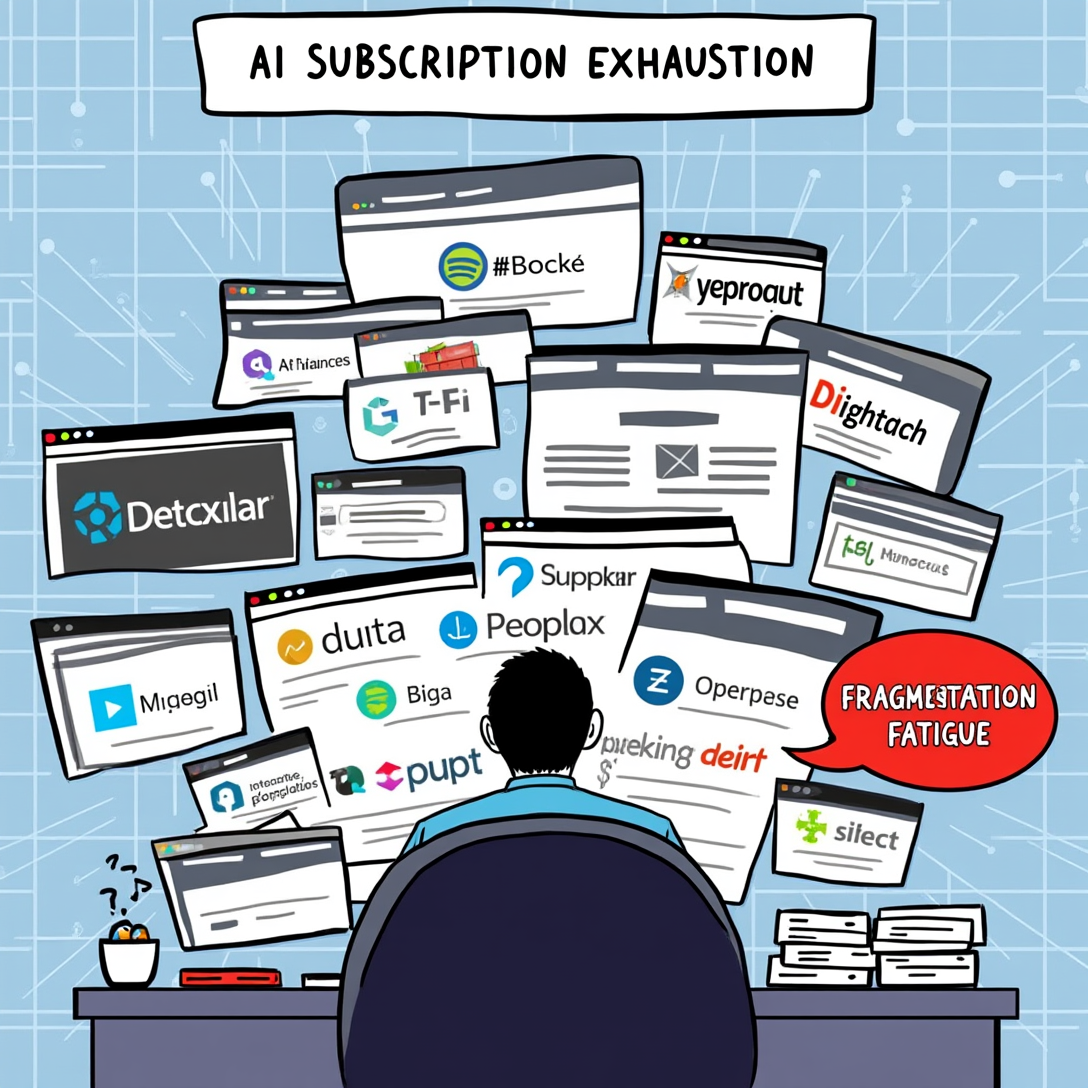
The AI Subscription Stack: Why You're Paying $100/Month and Still Switching Tabs
If you are a "power user" in 2024, you've probably fallen into the AI Subscription Trap.
It starts innocently. You get ChatGPT Plus for the general utility. Then, you realize Claude 3.5 Sonnet is significantly better at coding and nuanced writing, so you add Claude Pro. Then, you want the massive context window and Google ecosystem integration of Gemini Advanced. Finally, you add Perplexity Pro because you're tired of hallucinations and want real-time citations.
Suddenly, your "productivity stack" looks like this:
Service Cost ChatGPT Plus $20/mo Claude Pro $20/mo Gemini Advanced $19.99/mo Perplexity Pro $20/mo Total ~$80/mo
For some, adding Midjourney or a specialized API tool pushes that number over $110/month — nearly $1,300 a year spent on text boxes.
But the real cost isn't the money. It's the Cognitive Tax.
The "Tab Dance" Friction
Despite paying a premium for every top-tier model, the actual user experience is fragmented. We've all done the "AI Tab Dance":
- You start a prompt in ChatGPT, but the output feels too "robotic."
- You copy the prompt, switch tabs to Claude, and refine the tone.
- You realize you need a real-time fact check, so you jump over to Perplexity.
- You need to upload a 500-page PDF, so you head to Gemini.
We are paying for "the best of everything," yet we are spending a significant portion of our mental energy managing the tools rather than doing the work.
The Paradox of Overlap
Here is the frustrating part: the feature sets are converging.
Almost every one of these subscriptions now offers web browsing and search, image generation, file uploads and data analysis, and custom "GPTs" or Projects.
We are essentially paying four different companies for the same basic utility, simply because we want access to the specific underlying model that handles a particular task best.
We aren't buying different products; we are buying different "brains." But why is the cost of accessing those brains fragmented across four different billing cycles and four different interfaces?
The Case for Consolidation
The current state of AI consumption is unsustainable. "Subscription Exhaustion" is real. Users are tired of the $20-per-month increments and the friction of a fragmented workflow.
The logical evolution of the AI stack isn't another great model. It is a unified layer.
Imagine a single interface where the model is a toggle, not a separate subscription — where your history, your files, and your prompts live in one place, but you can swap the "engine" (GPT-4o, Claude 3.5, Gemini 1.5) based on the task at hand.
The goal shouldn't be to have the most subscriptions. The goal should be to have the most intelligence with the least amount of friction.
It's time to stop paying the "fragmentation tax."
Comments
Be the first to comment!